

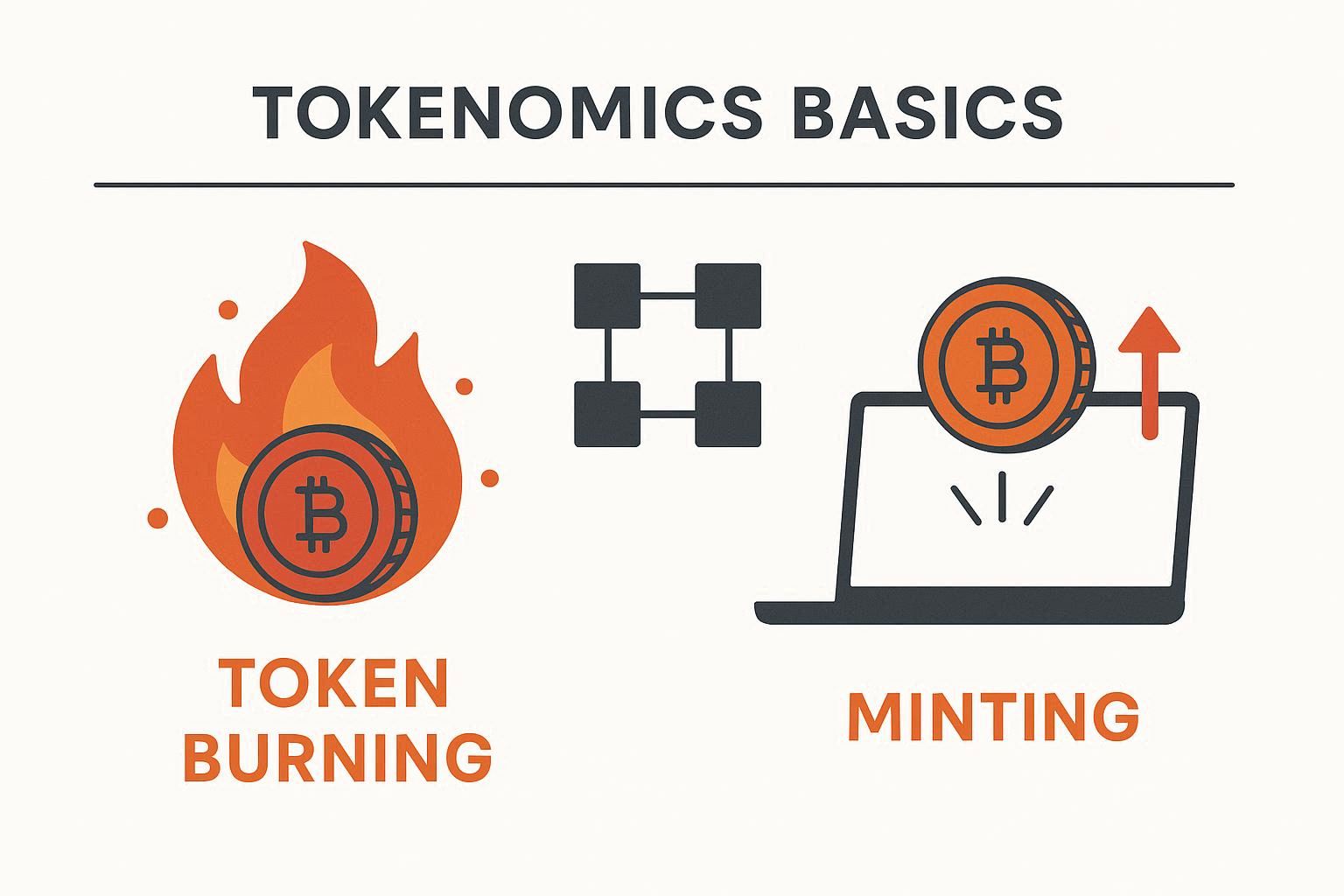
The hype of tokenomics grows as fast as the entire crypto industry. What is tokenomics? It is an umbrella term that represents all the economics behind a certain token or cryptocurrency. In this field, the most analyzed data is cryptocurrency minting and burning. These are the two quintessential factors to comprehending the economics of a project. This article covers the basics behind tokenomics and discusses token minting. In the next article of this series, we will discuss token burning, as well as its impact on the token.
What are the basics of Tokenomics?
The word tokenomics is an English word that originates from the merge of the two words; 'token' and 'economics'. It refers to the sustainability of a project and can be a great indicator of how a project works. Furthermore, it is often used to establish the worth of a particular project or digital asset. The economics behind a token is typically more complex than traditional economics. As such, it has received its own term. The reason for this additional difficulty is due to projects having the capacity to now destroy money. In traditional finance, you regard the in + outflow of money to ensure a company is profitable. However, in cryptocurrency, the money is programmable. This adds numerous additional factors to the equation. For instance, cryptos are destroyable, printable, and expirable. Furthermore, the decisions are taken for a project work differently.
Most projects in cryptocurrency rely on two main factors, even shitcoins rely on these basic tokenomic factors. Minting, which we will cover in this article, and burning, which we will cover in the next. These two terms contribute to the market cap of a project by modifying the total supply. But what is token minting exactly and how does it work?
Token Minting
Token minting is a part of tokenomics and refers to the process of digitally 'printing' more cryptos. It is employed by various projects to reward active users, keep the project sustainable, or grow sustainably. The minting feature essentially works as follows;
Primarily, the platform creates a smart contract with a pre-determined set of rules. Next, the user, or project interacts with the platform in the desired way to mint more cryptos. Lastly, the token (essentially a smart contract), verifies that the request respects the rules, and creates new tokens out of thin air.
Access to this function is typically either kept by a project or renounced to another smart contract. If the team keeps control of the mint function, they can essentially create as many tokens as they wish. This is not optimal as the project keeps full control of its tokenomics. Alternatively, if it is controlled by a smart contract, the rules for printing are either pre-determined, community-controlled, or publicly visible. Therefore, having the minting controlled by a smart contract is typically better than the team keeping full control over it.
Real-Life Examples
This process is recyclable and used across numerous different use cases. For instance, the famous stablecoin USDT works by having their customers transfer dollars to their bank accounts. Once the dollar arrives, a bot automatically prints USDT and transfers it to the user's desired account. This means that USDT as a company has total control of the printing of USD Tether.
Let's look at another example, MakerDAO. They released a stablecoin called DAI, which works in a decentralized manner. Furthermore, DAI runs based on decisions taken from the DAO of the Maker protocol. The tokenomics behind DAI are unique they enable the user to take decisions for the future of DAI, as long as they are part of the maker protocol. Therefore, a community owned & run, stablecoin.
Be aware, this does not necessarily mean that one project or the other will be more sustainable. However, it can be said with full certainty, DAI is much more transparent compared to USDT. Furthermore, as DAI is owned and run by the community, if it breaks from the peg, it would be their own fault. Whereas if USDT loses peg, the reason is bad management by the Tether company. Users would have little to no ability to change anything in this regard.
![Hypothetical Risks of Bitcoin (and PoW) [2022]](/images/posts/hypothetical-risks-of-bitcoin.webp)
Comments