

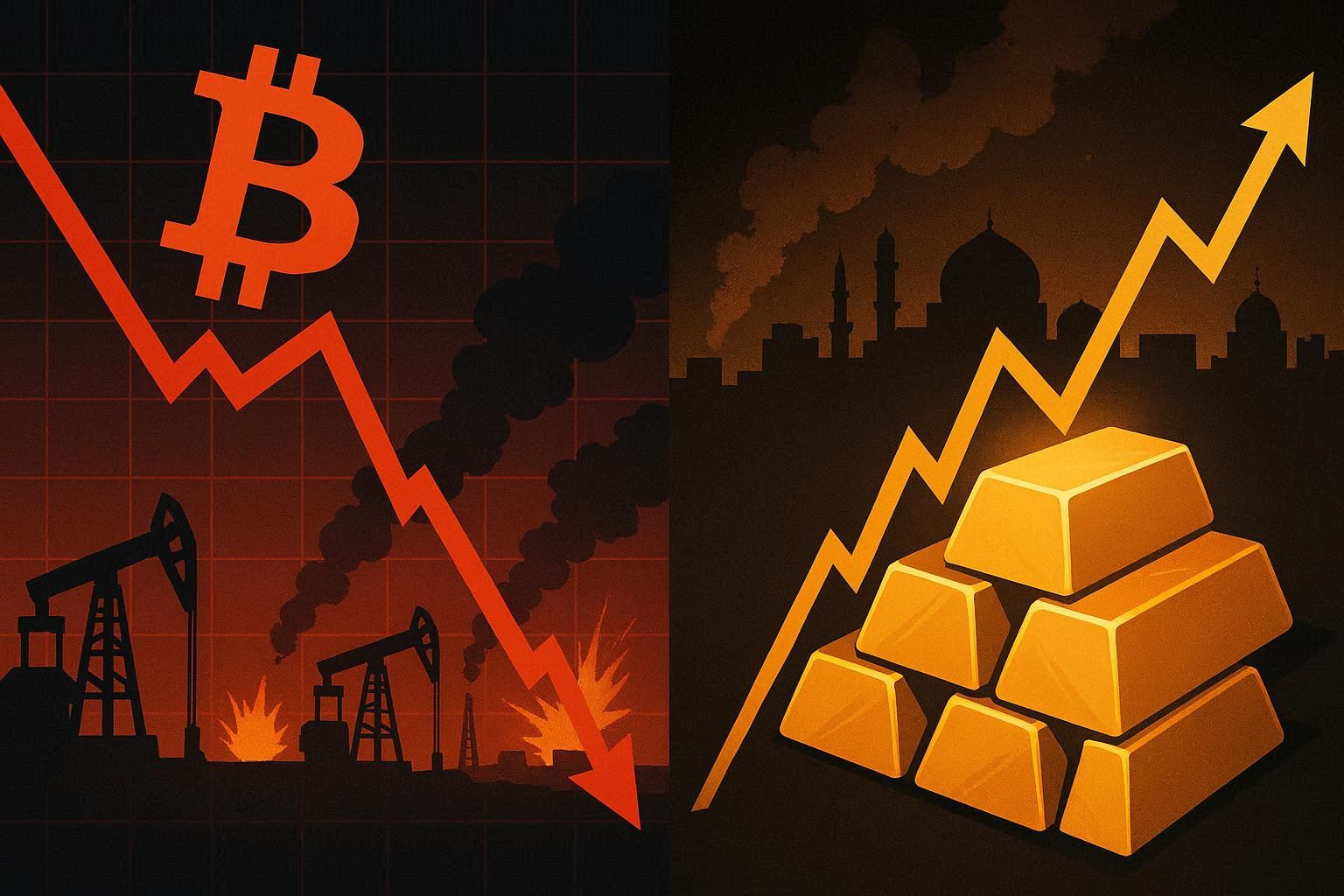
Breaking: Middle East War Sends Crypto Markets Into Freefall
February 28, 2026 — In what may prove to be the most consequential day for cryptocurrency markets in years, a joint US-Israel military strike on Iran has triggered a massive sell-off across digital assets, adding a new dimension of uncertainty to the already volatile crypto markets.
The numbers are staggering: $700 billion wiped from the crypto market in just 44 minutes. Over 150,000 traders liquidated. Bitcoin crashing through key support levels like paper.
Meanwhile, traditional safe havens—gold, silver, US Treasuries—moved in the opposite direction, gaining as investors sought shelter from the storm.
In simple terms: When geopolitical danger arrived, investors sold risky assets—including Bitcoin—and bought traditional safe havens like gold. Bitcoin and gold don't need to move in lockstep, but today's divergence highlights an important factor: Iran's state-sponsored Bitcoin mining operations could add another layer of volatility to crypto markets.
What Happened Today: Timeline of the Crash
| Time (UTC) | Event | Market Impact |
|---|---|---|
| 13:30 | Israel launches "preemptive" strikes on Iran | BTC: $67,200 |
| 13:35 | Trump confirms US military involvement | BTC: $66,800 (-0.6%) |
| 13:44 | Reports of explosions in Tehran | BTC: $64,100 (-4.6%) |
| 14:15 | Iran vows "devastating" retaliation | BTC: $63,500 (-5.5%) |
| 14:30 | 150,855 traders liquidated | Market cap: $2.17T (-$700B) |
By market close: Bitcoin sat at $63,419, down 6.24% in 24 hours. Ethereum fared worse, crashing 9.08% to $1,849. Solana and Dogecoin plunged over 10%.
The Numbers: $700 Billion Vanishes
The speed and scale of today's collapse is unprecedented even for crypto's volatile standards:
Market Impact (February 28, 2026)
| Metric | Value | Context |
|---|---|---|
| Crypto market cap loss | $700 billion | Evaporated in 44 minutes |
| Bitcoin price drop | -6.24% | From ~$67,600 to $63,419 |
| Ethereum price drop | -9.08% | Underperformed BTC |
| Traders liquidated | 150,855 people | $494 million in losses |
| Largest single liquidation | $12.8 million | One position wiped out |
| Gold price change | +2.1% | Proved actual safe haven |
| Oil price change | +8.4% | Supply disruption fears |
The Liquidation Bloodbath
According to CoinGlass data, the carnage was heavily concentrated among leveraged long positions:
- Long positions liquidated: $437 million
- Short positions liquidated: $56.8 million
- Liquidation ratio: 87.5% longs vs 12.5% shorts
This means the vast majority of traders were betting on prices going up—and got completely destroyed when war headlines hit the wires.
Bitcoin, Gold, and Different Roles in a Portfolio
Today's events highlight an important nuance in how different assets behave during crises. Bitcoin and gold don't need to correlate 1:1 to both have value in a portfolio—they serve different purposes.
How Different Assets Performed Today
| Asset | 24h Change | Behavior |
|---|---|---|
| Gold | +2.1% | ✅ Traditional safe haven |
| Silver | +3.4% | ✅ Precious metals strength |
| US 10Y Treasury | Yield fell 8bps | ✅ Fixed income safety |
| Bitcoin | -6.24% | Risk asset (high beta) |
| Ethereum | -9.08% | Risk asset (higher beta) |
| S&P 500 Futures | -1.8% | Risk asset benchmark |
Why Bitcoin and Gold Don't Need to Move Together
Bitcoin's "digital gold" narrative never meant it would mirror gold's price movements day-to-day. The comparison was always about scarcity and monetary properties, not correlation patterns. Consider:
Gold's advantages:
- 5,000+ years of monetary history
- Physical, tangible asset
- Deeply embedded in central bank reserves
- Proven crisis hedge over centuries
Bitcoin's advantages:
- Censorship resistance (can't be seized)
- Programmable money (enables smart contracts)
- Global accessibility (anyone with a smartphone)
- Fixed, known supply schedule (21 million cap)
These are different value propositions. Gold is the time-tested store of value. Bitcoin is the digital-native monetary network. Both can coexist.
What Today's Price Action Really Tells Us
-
Bitcoin behaves like a high-beta risk asset during acute market stress. This doesn't negate its long-term monetary properties—it just reflects current market dynamics.
-
Institutional ownership creates correlation. With major ETF providers holding Bitcoin, it's now part of broader risk-on portfolios. When institutions de-risk, Bitcoin sells alongside tech stocks.
-
Market maturity takes time. Gold has thousands of years of history. Bitcoin is barely 15 years old. Its role in global portfolios is still evolving.
Why Iran Matters for Crypto Markets
Iran isn't just another geopolitical flashpoint—it's uniquely positioned to roil global markets in ways that directly impact crypto.
The Oil Connection
Iran produces approximately 3.3 million barrels per day of oil (~3.3% of global supply). More importantly, it sits astride the Strait of Hormuz—through which flows 20-31% of the world's seaborne oil.
If Iran blocks the Strait:
- Oil prices could spike to $95-110 per barrel (from ~$72 currently)
- Global inflation would surge
- Interest rates would stay higher for longer
- Risk assets—including crypto—would face continued pressure
The Iran Crypto Mining Factor
Perhaps the most underappreciated aspect of this conflict: Iran has been operating one of the world's largest state-sponsored Bitcoin mining operations as a direct response to US economic sanctions.
Background: Sanctions Drive Iran to Bitcoin
Since 2018, when the US reimposed crippling sanctions on Iran's oil exports and financial system, the Iranian government turned to Bitcoin mining as an economic lifeline:
| Year | Development |
|---|---|
| 2018 | US sanctions intensify, Iran explores crypto mining |
| 2019 | Iran legalizes Bitcoin mining for registered operators |
| 2020 | Government grants 1,000+ mining licenses |
| 2021 | Iran commands ~4.5% of global Bitcoin hash rate |
| 2022-2023 | State-owned mining facilities expand rapidly |
| 2024 | Estimated 600+ industrial-scale mining farms |
| 2025 | Iran reportedly mining $1B+ in BTC annually |
Why This Matters for Today's Conflict
Iran's state-sponsored Bitcoin mining creates several unique dynamics during military conflict:
1. Emergency Bitcoin Selling
If Iran's power infrastructure is damaged or government funds run low, the regime may need to sell its Bitcoin holdings to fund military operations or pay for imports. With an estimated 50,000+ BTC held by state entities, this represents significant potential selling pressure.
2. Hash Rate Disruption
Military strikes on Iranian industrial zones could impact mining operations, potentially:
- Reducing global Bitcoin hash rate by 3-5% temporarily
- Increasing transaction confirmation times
- Affecting mining difficulty adjustments
3. Forced Liquidations by Iranian Miners
Even private Iranian miners (not state-affiliated) may be forced to sell Bitcoin if:
- Power becomes unreliable or too expensive
- Internet infrastructure is damaged
- They need funds to relocate or flee the country
4. Sanction Evasion via Crypto
There's also concern that Iran could use Bitcoin to circumvent sanctions:
- Accepting Bitcoin for oil exports (despite sanctions)
- Moving funds internationally without SWIFT
- Paying for weapons or supplies anonymously
The Broader Implications
This is the first major military conflict involving a significant state-level Bitcoin holder. How Iran handles its crypto reserves during this crisis could set important precedents:
- Will they sell? Hold? Use Bitcoin for transactions?
- How will the US respond to crypto-based sanction evasion?
- Could other sanctioned nations (Russia, Venezuela) follow Iran's lead?
Today's crypto sell-off may partially reflect these uncertainties. If Iran begins liquidating its Bitcoin holdings, it could add sustained downward pressure on prices.
What Experts Are Saying
Michael Burry's Warning
The investor famed for predicting the 2008 financial crisis has been skeptical of Bitcoin's safe-haven claims:
"Bitcoin is a pure speculative asset, not a hedge. When real fear arrives, money runs to gold, not crypto."
In early February 2026, Burry warned that if Bitcoin fell further, companies with large Bitcoin holdings could face significant losses. Today's sell-off partially validates this view—though the long-term question remains whether Bitcoin's behavior will evolve as the market matures.
Alternative Perspectives
Not everyone sees today's action as dispositive:
-
Long-term advocates point out that Bitcoin has existed during relative global stability. Its behavior during its first major war may simply reflect current market structure, not fundamental flaws.
-
Technical analysts note that Bitcoin was already overbought and due for a correction; the Iran news may have simply been the catalyst.
-
Monetary theorists argue that Bitcoin's similarity to gold is about hard money properties (fixed supply), not correlation patterns.
The "Contagion Risk" to Traditional Finance
Burry also highlighted a frightening mechanism: tokenized gold futures backed by Bitcoin collateral.
When Bitcoin crashes:
- Bitcoin collateral loses value
- Tokenized gold contracts face liquidation
- Gold positions are forcibly sold
- Contamination spreads to traditional markets
So far, we haven't seen evidence of this contagion—gold is up, not down. But the structural risk remains.
What Happens Next: Scenarios for Crypto Markets
The ultimate impact depends on how the Iran conflict evolves. Here are three scenarios:
Scenario 1: Limited Strike ("Best Case")
What it looks like: 4-day operation, Iran's response is constrained, oil flows continue.
Crypto impact:
- Bitcoin recovers to $65,000-68,000 within 1-2 weeks
- "Buy the dip" buyers return
- Market refocuses on fundamentals rather than headlines
Probability: ~35%
Scenario 2: Escalation with Oil Disruption
What it looks like: Iran mines the Strait of Hormuz, oil spikes above $90, inflation fears return.
Crypto impact:
- Bitcoin tests $55,000-60,000 support
- Extended bear market until oil stabilizes
- Fed forced to keep rates high longer
- Risk assets remain under pressure
Probability: ~45%
Scenario 3: Regional War (Worst Case)
What it looks like: US forces committed to regime change, Iran attacks Israel directly, other regional actors drawn in.
Crypto impact:
- Bitcoin could fall to $45,000-50,000
- Massive deleveraging across crypto markets
- Rotation away from ALL risk assets, including crypto
- Potential Iranian Bitcoin liquidations adding pressure
Probability: ~20%
What Should Crypto Investors Do?
Immediate Actions (Next 7 Days)
-
Review your leverage: If you're trading with borrowed money, reduce or eliminate it. Volatility will likely increase.
-
Assess your risk tolerance: If today's drop caused you significant stress, your position may be too large.
-
Don't catch falling knives: There's no rush to buy. Prices could go lower from here.
-
Watch oil prices: If Brent crude breaks $85-90, expect more pressure on risk assets including crypto.
Strategic Considerations (Next 3 Months)
-
Understand Bitcoin's current behavior: Right now, Bitcoin trades like a high-beta tech stock during crises. This doesn't mean it can't evolve into a safe haven over time—but don't count on it for crisis protection today.
-
Diversify with actual safe havens: Consider holding gold or gold mining stocks alongside crypto if you want traditional crisis protection. Bitcoin and gold serve different purposes.
-
Dollar-cost averaging wins: Trying to time geopolitical events is a loser's game. If you believe in crypto's long-term future, stick to your scheduled buys regardless of headlines.
-
Watch the Iran mining situation: Pay attention to news about Iranian Bitcoin sales or mining disruptions. This could be an additional source of volatility.
-
Prepare for continued volatility: The Iran conflict isn't ending soon. Expect more headlines, more fear, and more price swings—both directions.
The Bigger Picture: What This Means for Crypto
Today's events offer important lessons for how cryptocurrency fits into the global financial system:
Bitcoin and Gold: Complementary, Not Identical
The "digital gold" framing was always about monetary properties—scarcity, durability, fungibility—not about perfect price correlation. Bitcoin doesn't need to move like gold to be valuable. They can serve different roles:
- Gold: Crisis hedge, central bank reserve, 5,000+ year track record
- Bitcoin: Censorship-resistant money, programmable platform, global accessibility
The Iran Factor: A New Dynamic
This conflict introduces something crypto hasn't faced before: a major state-level Bitcoin holder under military attack. Iran's estimated 50,000+ BTC holdings and state-sponsored mining operations mean this conflict could affect crypto markets in ways we haven't seen before.
Watch for:
- Potential state-level Bitcoin liquidations
- Mining infrastructure disruptions affecting hash rate
- Crypto-based sanction evasion attempts
Institutionalization: A Double-Edged Sword
As BlackRock, Fidelity, and others have entered Bitcoin through ETFs, the asset has gained legitimacy—but also correlation with traditional markets. When institutions de-risk, Bitcoin sells alongside stocks.
This isn't necessarily bad. It means Bitcoin is becoming part of the mainstream financial system. But it also means crypto investors need to think about broader market dynamics, not just crypto-specific news.
The Long-Term Thesis Remains Intact
None of today's price action changes Bitcoin's fundamental value propositions:
- Censorship resistance: No government can seize your Bitcoin if you hold it properly
- Programmable money: Smart contracts enable financial products gold never could
- Global accessibility: Anyone with a smartphone can participate, regardless of borders
- Fixed supply: 21 million BTC, no more—ever
These properties don't disappear because prices drop during a geopolitical crisis.
Key Takeaways
-
Bitcoin and gold serve different purposes—they don't need to correlate 1:1. Gold is a time-tested safe haven; Bitcoin is a digital monetary network with unique properties.
-
$700 billion evaporated in 44 minutes—a reminder of crypto's extreme volatility and the importance of risk management.
-
150,000 traders were liquidated, mostly long positions using leverage. Avoid leverage during geopolitical uncertainty.
-
Iran's state-sponsored Bitcoin mining adds complexity—with an estimated 50,000+ BTC, potential Iranian selling could create additional market pressure.
-
Bitcoin currently trades like a risk asset, correlated with tech stocks more than gold. This may evolve over time, but don't count on it for crisis protection right now.
-
The Iran conflict could escalate—watch for oil price spikes and news about Iranian crypto operations.
-
Long-term believers should stay calm. If you believe in crypto's fundamental value, short-term volatility—geopolitical or otherwise—is part of the journey.
Related Reading
Want to understand more about crypto's role in your portfolio?
-
Hypothetical Risks of Bitcoin — Understanding the range of risks facing Bitcoin holders
-
Will Crypto Crash in 2026? — Historical context for crypto bear markets and recoveries
-
Understanding Market Cycles: Bull and Bear Markets — How markets move through cycles of fear and greed
-
How to Keep Your Bitcoin Safe — Security best practices for volatile times
-
What is a Short Squeeze in Crypto? — Understanding rapid price movements
Stay Informed: Follow Resh Community for ongoing coverage of how the Iran conflict affects crypto markets. We'll be updating this story as events develop.
Last updated: February 28, 2026 at 18:00 UTC
Data sources: CoinGlass, CoinGecko, Bloomberg, Reuters, Clash Search
Disclaimer: This article is for informational purposes only and does not constitute financial advice. Cryptocurrency investments carry high risk. Never invest more than you can afford to lose.

Comments