

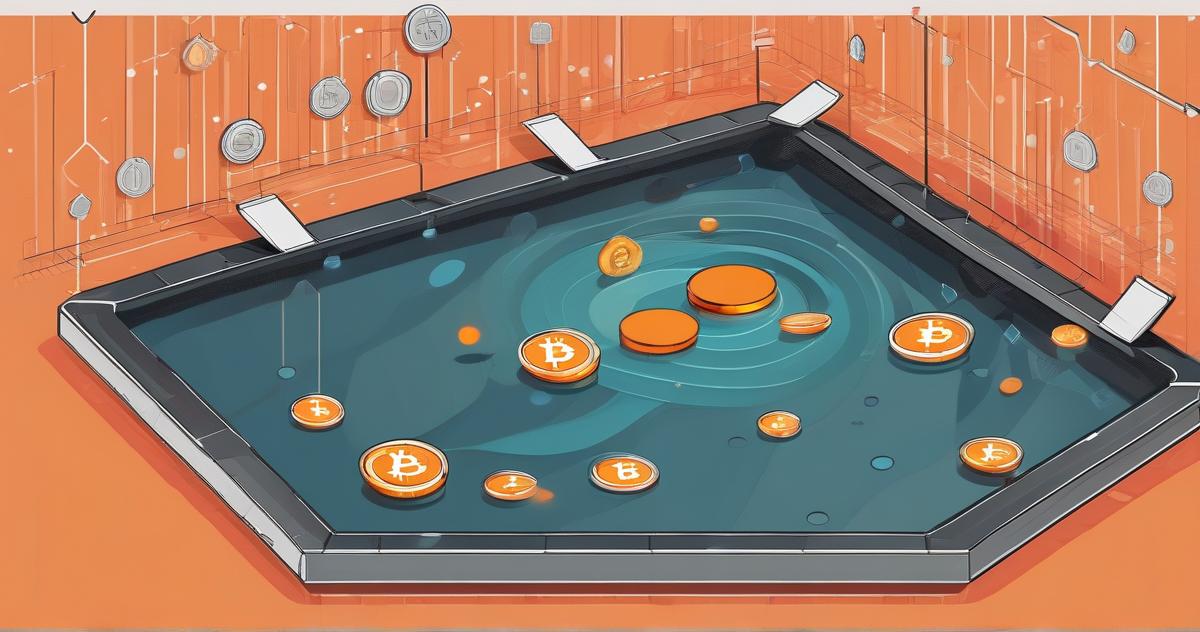
Liquidity Pools (LPs) are the backbone of DeFi technology. More particularly DEXs, but how does it work and what is it?
What are Liquidity Pools (LPs)?
Liquidity Pools is the concept of pooling funds together, and allowing others to use it for trade. They allow for a completely trustless and self-custodial trading without the need of a central party (unlike a CEX).
This re-defined and re-shaped the entire crypto sector. Furthermore, it allowed startups to thrive and grow in an uncontrollable, free environment.
How do LPs work?
Liquidity pools take on various forms and can operate differently depending on the DeFi protocol described. Typically, most projects follow Uniswap's technology. One of the main factors why is because they offered open-source code, and launched their product first.
How Uniswap LP works
Uniswap's liquidity pair protocol works in a very simple manner. Essentially, liquidity pools, rely on two pieces of the puzzle. The first piece, the supplier (commonly referred to as a LP provider), the second piece of the puzzle is the trader. To explain it simply, imagine the trader wants to trade between dollar and bitcoin.
First, the supplier has to deposit assets (in this case dollar and bitcoin) into the protocol in equal value. In order to find the exchange rate, one must divide the total amount of funds in the pool. For instance, to find the exchange rate between bitcoin and dollars, you could simply calculate: total bitcoin supplied / total dollars supplied. Because of the exchange fee, the liquidity pool grows with every trade. In theory, this becomes a growing pool of funds, equally shared among the LP providers.
Balancer Liquidity Pools
The second most notable algorithm behind liquidity pools, that of Balancer. Balancer's pool structure allows for any token composition and allows for users to change the underlying math of the protocol. Balancer offers 5 different types of LPs; The weighted pool, Stable Pools, MetaStable Pools, Liquidity Bootstraping pools, and finally managed pools.
Weighted Pools
Weighted pools are highly customizable and use weighted maths as described by Balancer. These two factors make weighted pools great for general use-cases (two tokens that seem to have no co-relation for example, USDT/BTC). These pools offered by Balancer, allows you to supply more than 2 tokens. Furthermore, Balancer allows you to create pools with different weights, for example (80/20) or (60/20/20). This allows the users to limit their exposure to certain assets.
Stable Pools
Balancer's stable pools are designed for tokens that keep the same value . For example USDC-BUSD, this is a pair were both are expected to remain at 1$. It relies on balancer's stable math protocol. The primary advantage of Stable Pools, is the Low price slippage (larger trades can be made for a cheaper cost).
MetaStable Pools
MetaStable pools is an extension of "Stable Pools" and uses the same underlying mathematics. It is designed for tokens with high price co-relation (but not completely pegged). For example, DAI/cDAI, as DAI and cDAI are meant to have the same price, however, cDAI earns interest over time and thus should gain more value than DAI slowly.
Liquidity Bootstrapping Pools (LBPs)
Liquidity Bootstrapping Pools offers the ability to modify the token weights dynamically. LBPs use the same mathematics as Weighted Pools, with time-dependent weights. The owner can set the start and end-time of the liquidity pool, shift the token weights based on time and pause trades. This is typically useful for new token launches as it avoids high price slippage.
Managed LPs
Managed liquidity pools offer the unique ability to create highly sophisticated portfolio strategies. The managed pools use weighted maths (same as LBPs, and Weighted Pools). What's unique about managed pools is the ability to create pools of up to 50 tokens. It also allows for time-based token weight shifting similar to the LBPs but offers many more features. Some of the other unique features offered by a managed LP are; Pool Manager, Management Fees, Liquidity Provider 'allowlist', Active token management (add/remove/change token weights) and a circuit breaker to protect from malicious / compromised tokens.
Boosted Pools
The Boosted Pools leverage the power of DeFi's Lend & Borrow protocols to maximize return. Boosted pools operate based on the Linear Pool component & mathematics. The way they operate is extremely unique and relatively complex compared to a traditional LP. The best technical explanation can be found in the Balancer docs.
Custom Pools
Lastly, balancer offers custom pools. They allow people to create custom trade equations and strategies. The advantage of using a custom pool is that all bookkeeping is handled by "The Vault" on balancer. Finally, the only required elements to create a custom pool is the functionality to join, trade and exit the pool.
Limitations of a Liquidity Pool
Whilst a LP may seem great, it still faces a lot of challenges and thus has it's own limitations. From lack of liquidity, to impermanent loss, liquidity pools are a double edged sword. One of the most common issues with them is a lack of liquidity (funds) to trade between two tokens. This can incur due to a variety of reasons, typically due to lack of interest/support or due to a rug-pull.
Without a doubt, the largest issue with liquidity pools is impermanent loss. Impermanent loss occurs when two supplied tokens' price move in opposite directions. The further apart the price moves, the bigger the impermanent loss. The name mentions 'impermanent' as if/when the assets move back to their original price, there would be no loss. However, some assets have absolutely no co-relation thus, the loss could be permanent. There are two typical solutions to this risk, either people use balancer's pools with a very high weight for one token (e.g 95/5), alternatively you can supply stable-coins which typically stay in the same price range.
Conclusion
Liquidity pools allows you to trade crypto in a peer to peer manner through decentralized exchanges. LPs allow liquidity pool providers to earn an income, paid by traders who wish to trade, without the need to relinquish custody of funds. We highly recommend analyzing impermanent loss prior to any investment.
What do you think about liquidity pools? Are they revolutionary? Will they change the world? Make sure to leave a comment and let us know what you think!

Comments