

Crypto Mining Made Simple
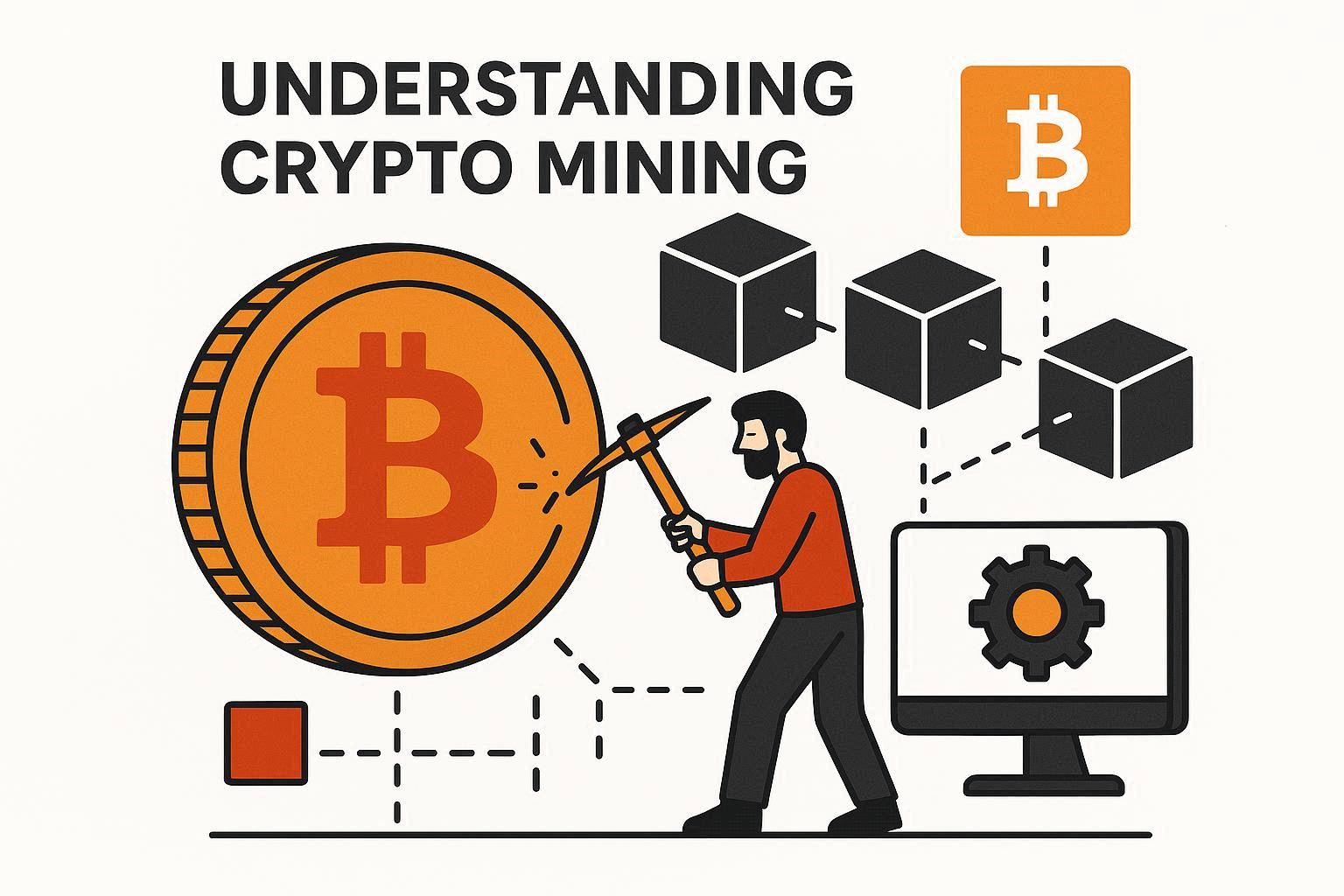
Crypto mining is the process performed by a certain machine to obtain cryptocurrencies. But, it has other purposes such as verifying blockchain transactions. Let’s discover what that actually means. (Read more about the blockchain in this article :<a href="https://resh.community/the-blockchain-and-its-impressive-use-cases/"> The Blockchain And Its Impressive Use Cases</a>)
Mining is actually the core, and the most important part of DeFi. It enables the crypto industry to work without any central authority or oversight. Moreover, It is essential in keeping cryptocurrencies secure, facilitating decentralized transactions, and allocating the newly mined coins into distributed ledgers.
So if you’re not looking into purchasing coins, mining is an interesting process to consider. In order to dig up those coins, you must solve some complicated puzzles. Then, you validate cryptocurrency transactions on a certain blockchain network and finally add them to a distributed ledger. But why does it require such elaborate work?
Digital platforms are easily manipulated which means that security measures are a necessity. If you’re not a verified miner, for instance, you won’t be able to update transactions on Bitcoin’s ledger. So mining helps add more security and reliability when it comes to the crypto sphere. It also prevents double- spending.
<style>/*! elementor - v3.8.1 - 13-11-2022 */
.elementor-widget-image{text-align:center}.elementor-widget-image a{display:inline-block}.elementor-widget-image a img[src$=".svg"]{width:48px}.elementor-widget-image img{vertical-align:middle;display:inline-block}  ## Crack the code
Crypto mining requires the miners to solve complex mathematical equations on their computers. In other terms, you need to crack the code that authorizes the transaction. Only by doing so, you earn a cryptocurrency. This validated` transaction will go live on a blockchain –the public ledger-, which means that this data is now secure and well encrypted.
For those who don’t have a lot of computing power, they can join mining pools which will help them earn a solid income. You can also do it independently. However, the chances of you solving a block on the chain by yourself are low. Still, if you do crack the code alone, you’ll fully earn the crypto reward without sharing it with your counterparts.
		## What are the tools that you need?

	First and foremost, you need a strong and very powerful computer that handles the load of pressure it takes to mine. You’ll also need your crypto wallet that will store your private key. The private key allows you access to cryptocurrencies while keeping them safe and only accessible by you.<br role="presentation" />
After making sure that you got your tools, you can decide to join a mining pool. This step isn't necessary but it will definitely ensure a higher percentage of success. A mining pool groups a number of miners who combine all of their resources to maximize profit potentials and mining power. However, remember that joining a pool also means having to split profits.
		## How does it actually work?

	PCMag defines mining as “The competitive process that verifies and adds new transactions to the blockchain for a cryptocurrency that uses the proof-of-work method. The miner that wins the competition is rewarded with some amount of the currency and/or transaction fees.” So what is <br role="presentation" />“proof-of-work”?<br role="presentation" /> As per definition, the proof-of-work algorithm, or PoW, is a decentralized consensus mechanism that provides members with arbitrary mathematical riddles to solve for the sole purpose of preventing hacks into the system.
Therefore, a proof-of-work consensus protocol makes sure that only “licensed” or verified crypto miner can validate transactions through mining. The PoW protocol is to keep mining safe, and to prevent hackers from gaming the system.
So proof of work is one of the methods that allows you to publish blocks in the chain. If you’re mining, your computer is performing micro-computations to transform given input data into an specific required output. Those who first produce and share the required output, gains crypto. Of course, before sharing the output on the network, they must double-check that it is functioning well.
 ## Proof of Stake: an eco-friendly alternative
You can also validate blockchain transactions through proof-of-stake. Technically speaking, proof-of-stake is not actually mining. It allows cryptocurrency holders to consider their own existing coins as collateral so they could be used as coins to validate a block.<br role="presentation" />
These coins are randomly picked out from the large pool of candidates who have added their coins as collateral. Proof-of-stake is therefore more ecofriendly because less people are using the enormous amount of energy needed to validate a block on the chain. Plus, they all get their coin rewards because there’s no race to be the first one to share the output.
So people are not wasting computing energy on mining for the coins and then failing to acquire them. According to the society of Computers and Law, proof-of-stake spends 99% less energy than proof-of-work.
To put it simply, proof of stake, computers work together to validate the blockchain (could be through a process called "sharding" which fragments data with miners) rather than competing (and having all miners store a record of the blockchain).
		## What are the different mining methods?

	**ASIC mining**: you can mine via an application-specific integrated circuit, also known as ASIC. This method is used to mine a specific cryptocurrency. It offers the highest hash rate. Thus, it offers more mining power, making it expensive.
GPU mining: you can also mine via one or more advanced graphic processing units which are known as GPUs or graphic cards. This method offers considerable mining power and it can be costly.
CPU mining: using a computer’s central processing unit –a CPU- is also an option. It is a very accessible and mainstream method to mine crypto. However it’s not as powerful and efficient as GPUs and ASICs. As a consequence, its profits are usually minimal.
Mining pools: they group miners who gather their talents to mine crypto and then share their block rewards. And of course, there’s a small pool fee that they must pay in order to participate in mining pools.
Solo mining: As its name indicates, you can mine on your own. This method can be harder than pool mining since it makes it difficult to earn block rewards.
Cloud mining: Cloud mining is when you pay a third party to mine crypto for you through their own devices. It requires a contract with terms that typically favor the company, and not the miner.
		## The purpose of mining in one cycle

	Mining is a fruitful cycle. Miners keep the blockchain rolling and secure while the blockchain rewards them with coins. Thus, the coins are a great motive for crypto miners who keep the blockchain rolling and secure.
Comments